
The two PMs called upon all countries to work towards rooting out terrorist safe havens and infrastructure.

Stepping up his offensive against the Congress, he asked the party to "repent" for what it has not done in the last 60 years.

PM Modi addressed the Sri Lanka Parliament on Friday.

Prime Minister Narendra Modi is in Tanzania where he held talks with Tanzanian President John Pombe Joseph Magufuli.

Advising judiciary to avoid "perception-driven" verdicts, Prime Minister Narendra Modi on Sunday said it should have an internal mechanism of "self-assessment" as judges are considered "divine" and seldom face any criticism unlike the political class.

"The basic idea is that India would like to continue to be the most beautiful woman wooed by all men, notably the two strongest in the house, US and China," the article titled 'Indo-US strategic distrust stalls LSA signing'.

'While economic ties are making incremental progress, it is in the security and strategic domains that the India-Japan synergy is more compelling,' says Dr Rajaram Panda.

'There are major implications for India. Though there was a transparently thin attempt to project the troop reduction as intended to promote peace, the downsizing is actually part of plans to streamline and strengthen the PLA, capable of defending China's national interests at home and abroad,' says Jayadev Ranade.

'China refuses to talk to India on nuclear or ballistic missile issues and conclude any de-targeting agreement as Beijing did with Russia or a non-targeting agreement with the US.'

The new government needs to clearly insist on diplomatic reciprocal arrangements with China. While reciprocity is a function of power in bilateral relations, the Modi-led government's responses should be based on India'S inherent strengths, says China expert Srikanth Kondapalli.

He said that as the previous government could not do it, he had to do it.

As Japan beefs up its defences against China, both New Delhi and Tokyo seem to have decided to re-energise their relationship to ensure a strategic balance in Asia. It is a clear signal that they may be ready to work together in containing if not confronting China, says Nitin Gokhale.

'The book has immense value because it reveals the inner workings of the think-tank which appears to provide facts and insights to Modi, though he himself takes the final decisions and articulates them in his characteristic rhetorical style,' says Ambassador T P Sreenivasan.

Chinese President Xi Jinping has suggested five thrust areas to improve relations with India. It is likely all these issues, in addition to the points raised by Xi at Fortaleza, will be part of the joint declaration at the end of his visit to India, says Srikanth Kondapalli.

'Difficult issues should not be brushed under the carpet, but should be raised upfront, particularly by India. While engagement and dialogue are always welcome and desirable, there should be some tangible results. Mere signing of agreements, MoUs, joint declarations are not enough.'

'Here in Delhi, the Modi government is supposedly looking at 'options' to hit back at Pakistan in any whichever way it can, while in Washington, the Obama administration is looking for ways to strengthen US military cooperation with Pakistan,' says Ambassador M K Bhadrakumar.

The two countries also signed three other agreements -- to enhance aviation links, to jointly work in the area of energy efficiency and promotion of parliamentary cooperation.
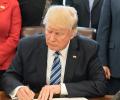
India needs to consider whether the Donald Trump administration can actually deliver, observes former foreign secretary Shyam Saran.

'The India-France relationship has been that of the elites of two countries, who appreciate each other's philosophical traditions -- whether it is ancient Indian civilisation and Sanskrit texts or the French tradition of Rene Descartes, Albert Camus, (Jean-Paul) Sartre... This is a drawback. It doesn't create the buzz, the excitement necessary for a relationship. We need more people-to-people contact, especially among students,' says former Ambassador to Paris, Rakesh Sood.
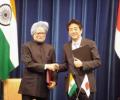
India's commitment to an open and plural security architecture attests to the fact that Asia's transition is a dynamic of both power & identity, says Zorawar Daulet Singh

At a time when Donald Trump is making belligerent noises, Chinese President Xi Jinping responds by overhauling the People's Liberation Army and restructuring the command of the PLA Navy to emphasise Beijing's resolve to dominate the South China Sea.

'China made it evident that neither the swing-ride at Ahmedabad nor the red carpet at New Delhi worked, by timing its muscle-flexing in Ladakh to coincide with Xi's visit.'

There are still a few lingering issues towards the progress of India-China bilateral relations, the approach for dealing with each other seems to be quite different. With Modi-Xi bonhomie strengthening, it seems that India and China are ready to recalibrate their approaches towards each other, says Sana Hashmi.

Launching a fresh attack on Defence Minister A K Antony, Narendra Modi on Tuesday charged that the country's defence had suffered seriously during his stewardship and said he owed an explanation to the people for this.

The Indo-US defence relationship may now get personal attention with strong India-backer Ashton Carter today being nominated by President Barack Obama for the key post of the defence secretary.

'The worst case scenario is for China to behave like a bull in China shop, and brazenly and wantonly indulge in further encroachments, create obstacles to free navigation and convert SCS into an Air Defence Identification Zone.'

The known unknowns in Prime Minister Modi's Saudi visit assume great significance, says Ambassador M K Bhadrakumar.

'The defence minister needs to focus on human resources-related issues at the same pace in 2017 as he did on acquisitions in 2016,' says Brigadier S K Chatterji (retd).

India's military prowess and multi-hued images of the country's rich cultural diversity and achievements in various fields were on display at the majestic Rajpath on Tuesday during 67th Republic Day parade which was graced by French President Francois Hollande as the chief guest.

He said he has always maintained that instead of fighting with each other, India and Pakistan should together fight against poverty.

The arrival a couple of days ago of a Chinese nuclear submarine for the first time in Karachi port, coinciding with a Chinese military delegation's visit, points to Pakistan's importance for China, says former R&AW officer Jayadeva Ranade.

'No matter how severe sanctions the UN security council imposes on North Korea, the impact of the sanctions would depend on how faithfully they are enforced by China,' says Dr Rajaram Panda.

'Trump's stated strong stance against Islamist extremism and terrorism could play into the Indo-US relationship.' 'It could mould US attitude and exert pressure on Pakistan.' 'In the event of US military presence in Afghanistan increasing, however, Pakistan could gain an opportunity to again emphasise its importance.'

India has given a clear indication that killing of its five soldiers on LoC by Pakistan Army will delay the Indo-Pak Secretary-level talks, asserting that dialogue can only proceed in an environment free of violence and terror.

Moving ahead with their new mantra -- Chalein Saath Saath: Forward Together We Go -- Prime Minister Narendra Modi and United States President Barack Obama on Tuesday vowed to deepen cooperation in every sector for the benefit of global stability and people's livelihoods over the next ten years.
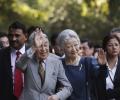
In the media frenzy over inconsequential issues, the visit of the Emperor of Japan to India has been pushed to the margins of public discourse. Colonel (retd) Anil Athale explains the great historical and political significance of the visit.
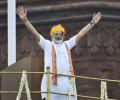
Following is the full text of Prime Minister Narendra Modi's address from the ramparts of the Red Fort on the 73rd Independence Day.

From early indications, the Modi government's foreign policy seems to be pragmatic and reciprocal, says K G Suresh.

When Vietnam's India born Foreign Minister Pham Binh Minh arrives in New Delhi on Wednesday evening, he will have many areas of similar interest to discuss with his counterpart, External Affairs Minister Salman Khurshid.

The prime minister's outreach to Japan is a recognition of the civilisational potential that the two nations hold and can wield in evolving an era of 'Asianism' in global politics, says Anirban Ganguly.
